
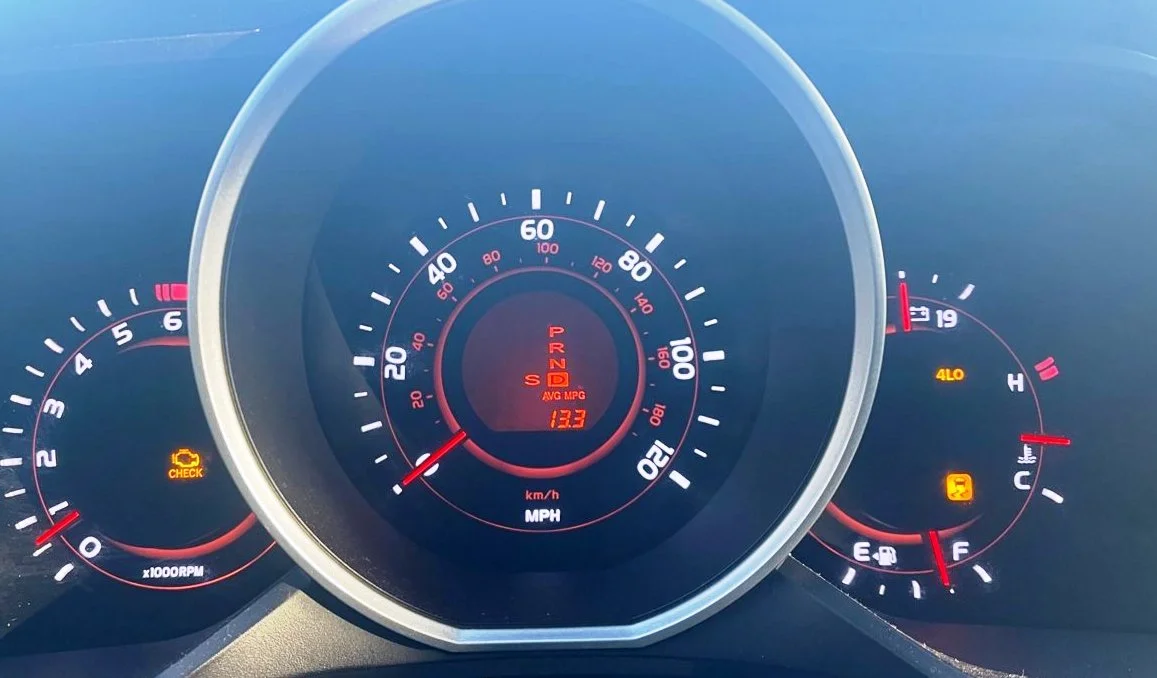
4Runner Check Engine, VSC & 4Lo Lights On Together
Three warning lights. Usually one fault code.
That surprises a lot of 5th gen 4Runner owners. The dash lights up like the whole truck failed at once.
In most cases, though, a single engine-side problem trips the check engine light. The other two lights come on because of it.
Sometimes that one problem is as small as a loose gas cap.
This guide covers why one fault triggers three lights, which codes show up most often, and what to check before you book a dealer visit.
It draws on Toyota owner’s manuals, NHTSA complaint records, and reports from 4Runner owners.
Who This Applies To
This pattern is mostly a 5th gen (2010-2024) Toyota 4Runner behavior. That generation uses the 4.0L V6 (1GR-FE) and a 5-speed automatic.
What you see depends on your drivetrain:
| 5th gen setup | Typical trims | What you’ll likely see with an engine fault |
|---|---|---|
| 2WD | SR5, Limited 2WD | Check engine + VSC/slip light. No 4Lo light, because there’s no 4Lo. |
| Part-time 4WD | SR5 4×4, TRD Off-Road, TRD Pro | Check engine + VSC/slip light + flashing 4Lo |
| Full-time 4WD with locking center diff | Limited 4×4, some Nightshade and other trims | Check engine + VSC/slip light + flashing 4Lo (and possibly the center diff lock indicator) |
Here’s a quick symptom shortcut. If you have a 2WD truck and see check engine plus VSC, it’s the same issue. You’re just missing the third light.
6th gen (2025+) owners: your truck uses the 2.4L turbo i-FORCE or the i-FORCE MAX hybrid. It also has a different digital cluster and different message logic.
There isn’t much owner data yet on whether the same three-light cluster appears. Treat the 5th gen info below as background, not a rulebook. Hybrid-specific alerts are a separate topic.
Why One Engine Fault Lights Up Three Warnings
Your 4Runner isn’t one computer. It’s several control units sharing data over a network. The three that matter here are:
- Engine control module (ECM). It sets the fault code and turns on the check engine light.
- Skid control ECU. It runs VSC (stability control) and TRAC/A-TRAC (traction control).
- 4WD control ECU. It runs the transfer case logic and 4Lo indicator on 4×4 trims.
VSC and traction control don’t only use brakes. To stop a slide, they also ask the engine to cut power. That only works if the engine data is trustworthy.
So when the ECM logs a fault, the skid control ECU plays it safe. It switches VSC/TRAC into a limited or disabled state and turns on its warning light.
You still have normal brakes. You’ve lost some of the automated help.
The flashing 4Lo light works the same way. The 4WD system uses engine and vehicle data too.
When something upstream reports a fault, the 4Lo indicator flashes as a “system not fully available” signal. It doesn’t mean your transfer case broke.
Toyota’s owner’s manuals don’t spell out this chain in plain English. The manual’s guidance amounts to: if the malfunction indicator comes on, have the vehicle inspected.
The cascade logic above comes from how the systems share data. It’s also backed by how consistently owners report the lights clearing together once the engine code is fixed.
The Myth Worth Correcting
“Three lights means three problems, and my 4WD is shot.”
Owner reports point the other way. When owners share their scan results, they usually find one engine code and no separate 4WD or ABS code.
Fix the engine code, clear it, and all three lights normally go out together.
The exception: if the check engine light goes out but VSC or 4Lo stays on, you may have a second, separate problem. More on that below.
Steady vs. Flashing
Before you diagnose anything, look closely at the check engine light itself.
- Steady check engine light: A fault is stored. It’s usually safe to drive gently to a parts store or home while you sort it out.
- Flashing check engine light: This typically means a severe misfire that can overheat and damage the catalytic converter. Ease off, and avoid heavy throttle and towing. Get it checked soon. If the engine is shaking badly, pull over and stop.
A flashing 4Lo light is normal in this scenario. A flashing check engine light is not. Don’t confuse the two.
Check the Gas Cap Before You Panic
This is the cheapest fix, so start here.
The 4Runner’s evaporative emissions (EVAP) system checks itself for leaks. A loose, cross-threaded, or worn gas cap can register as a leak and set an EVAP code.
On a 5th gen, that can be enough to bring on the full three-light display.
What to do:
- Park, shut the truck off, and remove the gas cap.
- Check the rubber seal for cracks, flattening, or debris.
- Reinstall it and turn until it clicks. Toyota’s manuals describe tightening until you hear a click.
- Drive normally for a few days.
Be patient. The lights often won’t turn off right away.
The ECM has to rerun its EVAP self-test over one or more drive cycles. That can take several days of normal driving.
Owners commonly report the lights clearing on their own after the cap was tightened.
If you have a scan tool, you can clear the code right away.
Don’t clear codes right before a state emissions test, though. Clearing them resets your readiness monitors, and the truck may not pass until they finish running again.
The OBD-II Codes 5th Gen Owners Report Most
If the gas cap isn’t the problem, get the code read.
Many US auto parts chains will scan it for free. You can also buy a basic OBD-II reader for roughly $20-40.
The table below groups codes that 5th gen owners report again and again. It’s based on owner reports, not an official Toyota frequency ranking.
| Code(s) | What it points to | Common reported causes | Typical difficulty |
|---|---|---|---|
| P0455, P0456, P0441, P0442 | EVAP leak or flow problem | Gas cap, cracked EVAP hose, purge valve (VSV), charcoal canister | Easy to moderate |
| P0171, P0174 | Both banks running lean | Dirty MAF sensor, intake leak after the MAF, aftermarket intake oiling the MAF | Often DIY |
| P0300-P0306 | Random or cylinder-specific misfire | Coil pack, spark plug, injector | Moderate (rear plugs take more labor) |
| P0420, P0430 | Catalyst efficiency | Aging cat, upstream sensor, or an exhaust leak | Moderate to expensive |
| P2440, P2441, P2442, P2443 | Secondary air injection system | Air injection pump or switching valve, often linked to moisture | Moderate to expensive |
| O2 / air-fuel sensor codes (P0130-P0161 range, P2195-P2198) | Sensor or heater circuit | Aging sensor, wiring | Moderate DIY |
A few model-year notes:
- Secondary air injection (P244x codes): Owner reports cluster around the earlier 5th gen years. They often follow rain, deep water, or a pressure wash. Toyota extended warranty coverage on this system for some trucks with related engines, so check whether your specific VIN qualifies.
- Lean codes after an intake upgrade: Oiled aftermarket air filters are a frequently blamed cause of contaminated MAF sensors. Cleaning the MAF with dedicated MAF cleaner is a common owner fix.
- Misfires on high-mileage trucks: The 1GR-FE generally has a reputation for durability. Even so, coils and plugs wear out. The rear-bank plugs take more labor to reach.
For bigger repairs, RepairPal’s estimator can give you a local labor range.
Getting a second quote on secondary air or catalytic converter work is reasonable.
When It’s Not the Engine
Most of the time, the check engine light is the root cause. But watch for these patterns:
Check engine stays off, but VSC and 4Lo are on.
This points away from the engine. Likely suspects include a wheel speed sensor, a brake-related fault, or a 4WD system issue.
A basic code reader may not see ABS or 4WD codes. You’ll need a scanner that reads those modules, or a shop visit.
If the 4Lo light is your main symptom, see our guide on 4Runner 4WD light blinking causes.
All three appear after a jump-start or with a weak battery.
Low voltage can make several modules log faults at once. Owners describe random light clusters that disappear after a battery replacement.
If your truck has been slow to crank, read our guide on why a 4Runner’s 12V battery drains.
You only see “TRAC OFF” or “VSC OFF” text.
That may just be a system you switched off with a button, not a fault.
Our explainer on TRAC OFF, VSC OFF and A-TRAC lights covers which is which.
Engine code fixed, but VSC or 4Lo won’t clear.
Assume a second issue and scan the other modules.
Can You Still Drive It? Can You Use 4WD?
Here’s a practical read based on owner reports and standard Toyota guidance.
- Daily driving on pavement: Usually fine with a steady check engine light. Drive gently, and remember you may not have stability control backing you up. Take extra care in rain, snow, or sharp emergency maneuvers.
- Towing: Wait until it’s diagnosed. Misfire and lean conditions get worse under load.
- Off-road or in 4Lo: Owners report that 4WD may engage mechanically. But A-TRAC, Crawl Control, and Multi-Terrain Select can be unavailable while the fault is active. Don’t count on traction aids on a trail until the code is cleared.
- Flashing check engine light: Minimize driving and get it looked at soon.
There’s a gap between Toyota’s official line and what owners do.
The owner’s manual says to have the vehicle inspected promptly.
In practice, many owners read the code themselves and fix simple causes like a gas cap or dirty MAF. They go to the dealer for EVAP leaks, secondary air faults, or anything they can’t trace.
Both approaches are reasonable as long as the light isn’t flashing.
For 6th Gen (2025+) Owners
The 6th gen shares its platform and much of its electronics with the current Tacoma.
Engine faults on the i-FORCE turbo or i-FORCE MAX hybrid may show up as cluster messages rather than the classic three-light pattern. On hybrids, warnings may say “Check Hybrid System” instead.
Owner data is still thin. If your 2025+ truck shows multiple warnings:
- Read the exact message text on the multi-information display.
- Check your 2025+ owner’s manual warning-light section.
- Keep in mind that a newer truck is likely still under Toyota’s warranty.
FAQ
Usually, yes. That happens once the underlying engine fault is fixed and the ECM confirms it over one or more drive cycles. Owners commonly report all three lights going out together. Clearing the code with a scan tool speeds this up.
Not usually, if the check engine light is also on. On 5th gen 4×4 trims, the flashing 4Lo light often reflects an engine-side fault rather than a transfer case problem. If 4Lo keeps flashing after the engine code is cleared, then look at the 4WD system.
Owners regularly report exactly that on 5th gen trucks. A loose or worn cap can set an EVAP leak code. That turns on the check engine light and brings VSC and 4Lo with it. Tighten the cap until it clicks and give it a few days of driving.
Your Checklist for Today
- Look at the check engine light. Flashing? Limit driving and get it checked soon.
- Remove and reinstall the gas cap until it clicks. Inspect the seal.
- Get the code read for free at a parts store, or with your own OBD-II scanner.
- Write the code down before anything gets cleared.
- Match it against the table above.
- If it’s a lean code and you have an oiled aftermarket filter, consider cleaning the MAF sensor.
- Avoid towing and trail driving until the code is resolved.
- Don’t clear codes right before an emissions test.
- If the engine code is fixed but VSC or 4Lo stays on, scan the ABS and 4WD modules.
- Check your VIN for open recalls at nhtsa.gov/recalls.